The Everest Base Camp trek with a helicopter return is a beautiful blend of real adventure and well-earned comfort, taking you right into the heart of the Khumbu region. You’ll follow time-honored mountain trails beneath towering Himalayan peaks, passing welcoming Sherpa villages, colorful prayer flags dancing in the wind, and peaceful monasteries that quietly tell stories of life in the mountains. Each day on the trail brings you a little closer to Everest, and with every step the excitement grows, the scenery opens up, the mountains feel bigger, and the journey becomes something you truly feel, not just see.
Compared to other treks in Nepal, like the Annapurna Base Camp Trek, the Everest Base Camp Trek offers a higher-altitude experience, a more remote trail, and unparalleled vistas of towering 8,000-meter peaks.
Reaching Everest Base Camp is more than just ticking off a destination; it’s a moment that stays with you. Standing among the icefalls and glaciers, surrounded by the tallest peaks on Earth, you truly feel how powerful and humbling the Himalayas are. Along the way, you pass through lively Namche Bazaar, soak in the peaceful atmosphere of Tengboche Monastery beneath the stunning Ama Dablam, and walk across the wide, rugged valleys of Dingboche and Lobuche. And when you finally make the climb to Kala Patthar, the effort feels completely worth it; the views of Everest, Lhotse, and Nuptse unfolding before you in the golden mountain light are simply unforgettable.
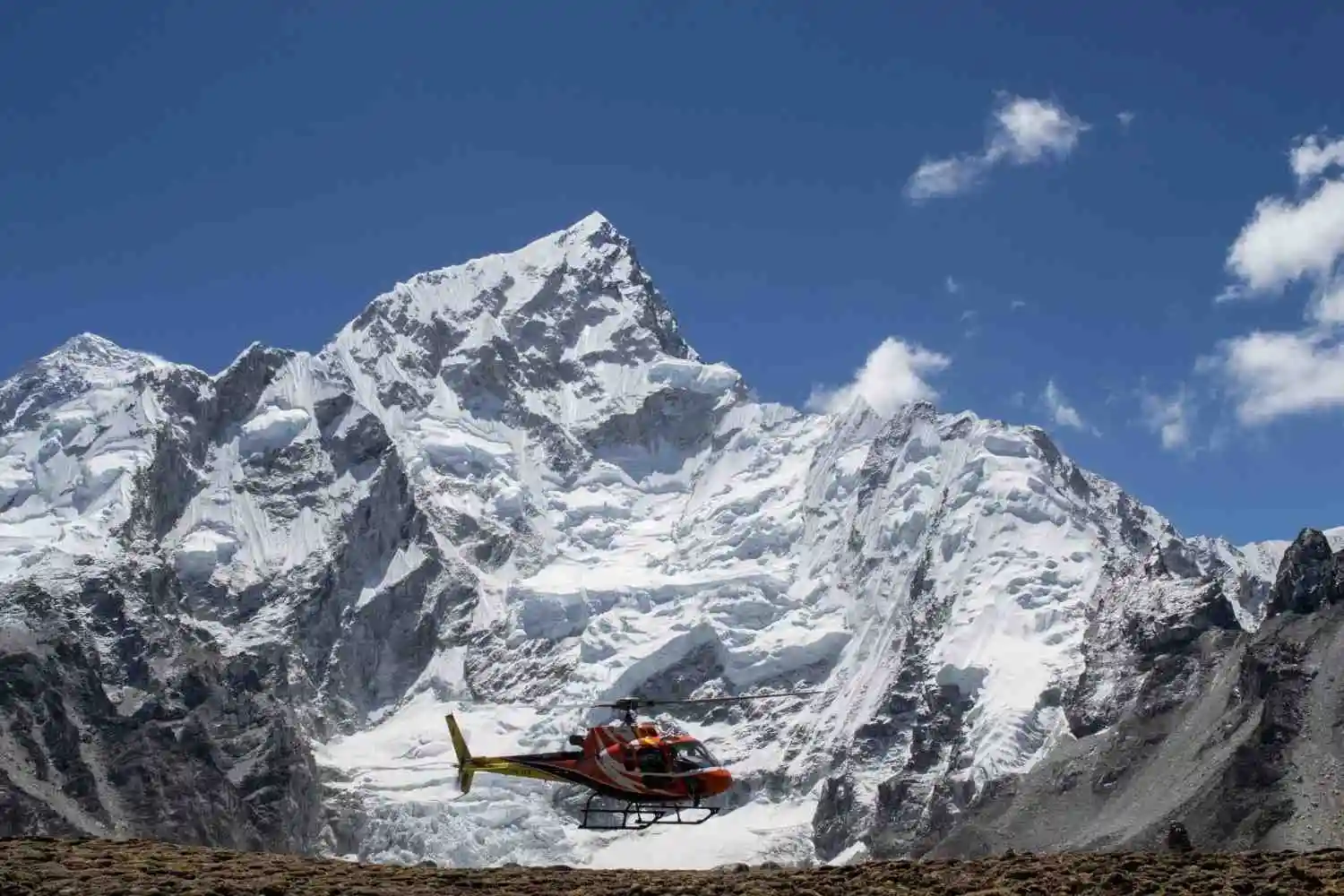
The journey concludes spectacularly with a helicopter flight back, transforming the return into an exhilarating aerial experience. Lifting off from the high Himalayas, you fly over glaciers, turquoise lakes, and deep valleys, enjoying a bird’s-eye view that few people ever experience. This beautiful ending not only saves days of downhill trekking but also adds a touch of luxury, leaving you with unforgettable memories of both the physical challenge of the trek and the thrill of soaring above the world’s tallest mountains.
 Country
Nepal
Country
Nepal
 Duration
8 Days
Duration
8 Days
 Difficulty
Moderate
Difficulty
Moderate
 Max. Altitude
5240 meters /
Max. Altitude
5240 meters / Prime Activity
Trekking
Prime Activity
Trekking
 Season
Autumn
Season
Autumn



Skip the tiring walk back and enjoy a glamorous helicopter ride over glaciers, valleys, and the famous Himalayan mountains.
View Lhotse, Nuptse, and Ama Dablam both along the hiking trail and from the air.
Experience the most panoramic views of Everest and the Himalayan range during the hike to Kala Patthar.
Walk through traditional Sherpa villages such as Namche Bazaar and Tengboche, and learn about the life and traditions of the local people.
Visit the spiritual center of the Everest region, set against a backdrop of snow-covered peaks.
Specially planned acclimatization helps make high-altitude trekking safer and more comfortable.
Enjoy warm hospitality, nutritious food, and comfortable lodging throughout the trek.
Combine the adventure of hiking to Everest Base Camp with the comfort and speed of a helicopter return.
Designed for travelers who want to experience Everest fully without the physical burden of a long descent.
The journey begins in Kathmandu with a scenic flight to Lukla, the gateway to the Everest region. From Lukla, the trail leads to Phakding along the Dudh Koshi River, crossing several suspension bridges decorated with prayer flags. The trek then continues to Namche Bazaar, the bustling Sherpa capital of the Khumbu Valley, where trekkers spend an acclimatization day while enjoying views of Everest and surrounding peaks.
The trail passes through pine forests and high ridges before reaching Tengboche, home to the most important monastery in the region. As the trek continues beyond Tengboche, the landscape gradually transitions into alpine terrain with fewer trees. The route passes through Dingboche and Lobuche, following the edge of the Khumbu Glacier and offering dramatic views of Himalayan giants such as Ama Dablam, Nuptse, and Lhotse.
On the final trekking day, trekkers reach Gorak Shep and proceed to the ultimate destination, Everest Base Camp. After visiting Base Camp and completing an optional hike to Kala Patthar for sunrise or sunset views, the return journey begins by helicopter. The helicopter flight provides spectacular aerial views of glaciers, ridges, and surrounding peaks before landing in Lukla and continuing onward to Kathmandu, concluding the adventure in comfort and style.
Nepal offers a visa on arrival to more than 90 nationalities. Entry is straightforward for travelers arriving at Tribhuvan International Airport in Kathmandu or at major land border checkpoints such as Kodari and Belahiya. Trekkers planning to complete the Everest Base Camp trek with a helicopter component must obtain a valid visa, which is required by immigration authorities to issue TIMS cards, national park permits, and rural municipality permits.
Travelers are strongly advised to carry sufficient funds, follow visa application procedures carefully, and complete all required paperwork. Overstaying or holding an invalid visa can result in fines, legal issues, or denial of entry.
Visitors can obtain a Nepalese visa through an online pre-application at evisa.gov.np or by completing a paper form at immigration desks. The following are required:
A passport with at least six months of validity
Two recent passport-size photos for paper applications
Cash payment in USD, with exact change recommended
Visa fees are as follows:
$30 for 15 days
$50 for 30 days
$125 for 90 days, multiple entries
Visa extensions are available at the Immigration Office in Kathmandu at an additional cost of $2 to $5 per day. SAARC nationals, except Indian citizens, receive a free 15- to 30-day visa, and children under 10 years are exempt from visa fees. Processing time typically ranges from 15 to 45 minutes, but may take longer during peak trekking seasons from October to December.
Tip: Applying online in advance helps avoid long queues. Travelers should also carry proof of onward travel or sufficient funds, estimated at around $100 per day.
Required documents include a completed application form, payment receipt, photographs, and a return ticket. Important points to note include:
Overstaying costs $3 to $5 per day, and repeated offenses may result in blacklisting
Land border visas follow similar rules, but usually close by 5 PM
Visa rules differ for Indian and Chinese nationals due to bilateral agreements
Only clean and undamaged USD bills are accepted
Visa denials are rare and usually result from passport issues or incomplete forms
For the EBC trek, visas must be secured before permits are issued and helicopter flights are confirmed. Always verify visa validity when applying for Sagarmatha National Park and rural municipality permits. Proper visa compliance prevents delays, extra costs, and potential cancellation of the helicopter return.
Best practices include:
Carry both printed and digital copies of your visa and passport
Ensure visa validity covers your trekking schedule, plus extra buffer days
Double-check entry and exit dates, as helicopter operators may require proof of a valid visa before boarding
All trekkers visiting Nepal for high-altitude expeditions, such as the Everest Base Camp trek with helicopter use are required to have travel insurance. From April 2025, Nepalese authorities require proof of insurance to issue TIMS cards, Sagarmatha National Park permits, and rural municipality permits. This ensures coverage for medical emergencies, accidents, and evacuation in remote Himalayan regions.
Proper insurance provides reassurance in situations such as altitude sickness, extreme weather, injuries, or flight delays. Without adequate insurance, trekkers may be denied permits, and helicopter operators may refuse service. Policies must clearly include medical emergencies, helicopter rescue, and trip cancellation coverage.
Travel insurance for the Everest Base Camp trek with a helicopter return must include comprehensive medical and evacuation coverage. In the Himalayas, help is not just around the corner, so having the right protection in place is essential for peace of mind throughout the journey.
Medical coverage should include treatment for illnesses or injuries at high altitude, ideally covering trekking up to around 6,000 meters. This includes conditions such as altitude sickness, frostbite, hypothermia, and other trekking-related injuries that can occur in cold and demanding environments. Proper coverage ensures you can receive necessary care without unnecessary stress.
Helicopter rescue and evacuation coverage is critical, as emergencies in the Khumbu region require air evacuation. In serious situations, trekkers may need to be evacuated from places like Gorak Shep, Kala Patthar, or Everest Base Camp. Your policy should clearly confirm high-altitude helicopter evacuation and specify whether it covers shared or private rescues, as well as possible weather-related delays.
Trip cancellation and delay coverage protects against financial loss caused by unforeseen events such as bad weather or flight disruptions. Mountain weather is unpredictable, especially on routes involving Lukla flights, so having this protection helps manage unexpected itinerary changes.
Personal liability coverage protects against accidental injury to others or damage to property during the trek, offering an added layer of security while traveling in remote regions.
Insurance is verified at permit checkpoints in Monjo, Lukla, or Phaplu. Trekkers must present either a digital or printed copy of the policy showing helicopter rescue coverage. Lack of proper coverage can result in permit denial.
Verification tips include:
Ensure the insurer is internationally recognized and accepted by helicopter operators
Confirm coverage applies to trekking and helicopter activities, not general travel only
Keep policy documents and emergency contact numbers, both printed and saved on your phone
Understand the claims process, which typically requires medical reports, receipts, permits, and submission within 30 days
Without adequate insurance, trekkers risk permit denial, financial loss, or serious danger in emergencies. The Himalayas present risks such as altitude sickness, weather disruptions, and injuries. Travel insurance ensures access to helicopter evacuation, emergency medical care, and safe recovery, allowing trekkers to focus fully on the experience.
The Everest Base Camp trek with helicopter return is not only a physical adventure but also a cultural journey through the heart of the Khumbu region. The trail passes through classic villages where traditional ways of life, religion, and mountain culture are closely intertwined. Knowledge about local traditions enhances the trek and makes it more meaningful.
The main population of the Khumbu region is the Sherpa community, recognized worldwide for their mountaineering skills and endurance. Sherpas are devout Tibetan Buddhists with a rich cultural heritage passed down over generations. In the lower Solu area, Rai communities are also present, adding cultural diversity to the region.
The Himalayan lifestyle is reflected in local languages, customary clothing, and agricultural practices. Engaging with the local people provides a great experience of life in the mountains during the Everest Base Camp trek with helicopter return.
Buddhist culture is evident along the trail in monasteries, Mani walls, prayer wheels, and colorful prayer flags. The most important spiritual site during the trek is the Tengboche Monastery, a serene location surrounded by Himalayan peaks.
Trekkers are expected to walk clockwise around stupas, Mani walls, and prayer wheels. The Everest Base Camp trek with helicopter return is enriched with these spiritual traditions.
Even basic gestures, like greeting locals with Namaste or Tashi Delek, wearing simple clothing, and seeking permission before taking photographs, are valued. Removing shoes before entering monasteries or houses and observing local practices helps develop positive relations during the trek.
The trek would be incomplete without porters, who carry luggage, food, and trekking gear through steep and challenging mountain paths. With their aid, trekkers move with lighter daypacks, save energy, and maintain acclimatization and safety without exhaustion.
Porters carry trekking equipment between villages and may sometimes walk ahead of the trekking group. One porter can typically carry the luggage of two trekkers, enabling steady movement. Their knowledge of the terrain and weather contributes significantly to the organization and efficiency of the trek.
Porters are accustomed to high altitudes and acclimatize easily. They play a critical role in the successful completion of the Everest Base Camp trek with helicopter return, especially during prolonged trekking days.
A porter usually carries between 20 to 25 kilograms. Responsible trekking companies strictly enforce these limits to avoid injuries and long-term health problems. Ethical practices include providing porters with appropriate clothing, shoes, meals, lodging, insurance, and healthcare.
Trekkers should pack responsibly and eliminate unnecessary items. Supporting ethical trekking agencies ensures fair treatment and sustainable tourism in the Everest region.
Porters work in physically demanding conditions, often in cold climates and high altitudes. They need sufficient rest, proper equipment, and fair compensation.
Tipping porters is customary as a sign of appreciation for their efforts. Fair tipping at the end of the Everest Base Camp trek with helicopter return helps porters sustain their livelihoods and supports their livelihood and recognizes their hard work.
One of the most unique aspects of the Everest Base Camp Helicopter Return Trek is flying to Lukla, widely recognized as an exciting and challenging aviation experience. Lukla Airport is situated at a high altitude, surrounded by steep mountain walls, making flight operations extremely sensitive to weather and visibility conditions.
Flights to Lukla are mostly scheduled in the early morning when winds are lighter and cloud cover is minimal. The Himalayan weather can change rapidly, and delays or cancellations may occur due to fog, snow, or strong winds. Helicopters offer more flexibility than fixed-wing aircraft since they are more maneuverable and can operate in slightly broader conditions. Nevertheless, safety remains the top priority, and flights are delayed if conditions are deemed unsafe.
Lukla Airport has a short, sloped runway with very limited go-around capability due to terrain, requiring a high level of piloting skill. Only pilots with extensive experience in mountain aviation and special certification to operate at Lukla are permitted to fly in and out of the airport. Careful weight management, precise flight scheduling, and continuous communication with air traffic control ensure safe landings and departures.
For trekkers, helicopter flights not only minimize the physical stress of travel but also provide a high level of safety in one of the most challenging aviation environments in the world.
If you are interested in a similar adventure in Nepal:
Accommodation plays a significant role in comfort and recovery during the Everest Base Camp trek with a helicopter return. In Kathmandu, trekkers stay in well-equipped hotels, while accommodation standards gradually change as altitude increases. Understanding what to expect at different stages helps trekkers prepare both mentally and physically for the journey.
Kathmandu offers a wide range of accommodation options for trekkers before and after the Everest Base Camp trek with a helicopter return. Most trekkers spend one or two nights in the city before departure for trip briefings, gear checks, and rest after international travel. Upon returning by helicopter, Kathmandu hotels provide much-needed rest, hot showers, and comfort.
Three-star hotels in Thamel typically offer clean rooms, Wi-Fi, attached bathrooms, and breakfast, making them suitable for moderate-budget trekkers. Five-star hotels provide premium services such as spas, swimming pools, quality dining, and airport or city transfers. Staying in Kathmandu allows trekkers to transition smoothly between city comfort and high-altitude trekking.
Once the trek begins from the city to the remote village, accommodation shifts to traditional teahouses between Lukla and Everest Base Camp. Teahouses are locally owned lodges that provide basic shelter. Rooms usually include twin beds, mattresses, pillows, and blankets, while bathrooms are shared. Heating is generally unavailable in bedrooms at higher altitudes, so trekkers rely on warm sleeping bags.
Teahouses in villages such as Phakding and Namche Bazaar are relatively comfortable, with some offering hot showers, charging facilities, and Wi-Fi for an additional fee. As altitude increases toward Dingboche, Lobuche, and Gorak Shep, facilities become more basic due to limited resources and harsh climatic conditions.
A limited number of luxury lodges are available in areas such as Lukla, Namche Bazaar, and Dingboche. These lodges offer private rooms with attached bathrooms, heated dining areas, and higher service standards. They are suitable for trekkers seeking extra comfort on the Everest Base Camp trek with a helicopter return.
Standard teahouses focus on affordability and authenticity. While facilities are basic, they provide a genuine Himalayan experience and meet the needs of most trekkers. The choice depends on budget, comfort expectations, and trekking style.
It includes a visit to Everest Base Camp with a helicopter return and meals during the trek and at the base camp.
Food is a vital aspect of maintaining energy and well-being during the Everest Base Camp trek with a helicopter return. Teahouse meals are a cultural part of the trek designed to be nutritious, warm, and easy to digest, which is essential for high-altitude trekking. Although food options decrease with altitude, meals remain consistent and nourishing.
Meals are mostly prepared using local ingredients in the teahouse kitchens. Dal Bhat, the traditional Nepali meal consisting of rice, lentil soup, vegetables, pickles, and sometimes meat, is the most popular and recommended option. It is highly nutritious and usually comes with free refills, making it ideal for trekkers who burn high calories each day.
Other commonly available meals include fried rice, noodles, pasta, momos, soups, thukpa, mashed potatoes, pancakes, and Tibetan bread. Bakeries in Lukla and Namche Bazaar offer pastries, bread, and coffee, adding variety to the trekking diet.
Breakfast is usually served in the morning and includes porridge, eggs, toast, pancakes, or Tibetan bread. Lunch is taken at a teahouse along the trail and is generally light to maintain energy while walking. Dinner is the main meal of the day and is eaten at the overnight stop, typically warmer and more filling to aid recovery.
Garlic soup is often recommended at higher altitudes, as it helps with digestion and warmth. Meals form an essential part of the daily routine during the Everest Base Camp trek with a helicopter return.
Snacks such as energy bars, chocolates, nuts, and biscuits provide quick energy during the trek. Hydration is crucial at high altitude, and trekkers are advised to drink at least four to five liters of water per day. Teahouses provide boiled water, and the use of water purification tablets or filters is strongly recommended to prevent illness.

Tenzing Sherpa
Have questions? Our travel specialists are here to help plan your perfect adventure.
Chat on WhatsAppThere's something about that early morning drive to the airport, the city still half-asleep, the excitement already buzzing, that tells you this trip is going to be different. Your adventure begins with a short but jaw-dropping flight from Kathmandu to Lukla, weaving between snow-dusted ridgelines as the Himalayas slowly reveal themselves outside your window. Landing at Tenzing-Hillary Airport is an experience in itself, with one of the most dramatic runways in the world perched on a mountainside. Once in Lukla, you'll meet your trekking crew, take a breath of that crisp mountain air, and let the reality of it all sink in. From here, the trail drops toward the left bank of the Dudh Koshi River, winding through stone staircases, small teahouses, and the rhythmic sound of the river below. By the time you reach Phakding, your legs will be warm, your appetite earned, and your excitement very much intact.
Today is the kind of day that reminds you why you chose this trek. Following the Dudh Koshi River northward, you'll cross a series of swaying suspension bridges, some hanging high above thundering water, while the trail passes through charming Sherpa settlements like Chumma, Benkar, and Jorsale. Just past Jorsale, you'll enter Sagarmatha National Park, where the forest thickens with rhododendron and pine and the air carries that earthy, alpine smell. The final push up to Namche Bazaar is steep, no sugarcoating that, but when you crest that last ridge and the town spills into view like a colorful amphitheater carved into the hillside, every step feels worth it. And if the clouds cooperate, your first proper glimpse of Everest from here will stop you in your tracks.
Think of today as the mountain's way of asking you to slow down and actually look around. Namche Bazaar isn't just a stopover; it's a proper Himalayan town with good coffee, warm lodges, gear shops, bakeries, and a social energy unlike anywhere else on the trail. Take your time exploring it. That said, your body acclimatizes better when you keep moving, so a short hike up to Syanbouche (3,790 m), the famous Everest View Hotel (3,880 m), or the traditional villages of Khumjung and Khunde is well worth it. The views from the ridge above town, with Everest, Ama Dablam, Nuptse, and Khumbila all lined up on the horizon, are the kind that make you reach for your camera and then just... put it down and stare. Note: If you're here on a Saturday, don't miss the Haat Bazaar, a weekly open market where traders from across the Khumbu gather. It's lively, colorful, and a genuine window into local mountain life.
Ask any seasoned trekker, and they'll tell you, this stretch is the one they remember most. The trail climbs through rhododendron and juniper forests that, in the right season, are absolutely ablaze with color. About two hours in, you reach Kyangjuma, where the trail forks, one way toward Gokyo, the other toward base camp. You're going straight ahead. A lovely descent brings you to Phunki Thenga, a quiet little riverside spot that's perfect for lunch and a moment of stillness before the final climb to Tengboche. That uphill section demands something from your legs, but what waits at the top more than pays you back: the great Tengboche Monastery standing against a backdrop of Everest, Ama Dablam, Lhotse, and Nuptse. If you can, time your arrival for around 3 p.m. and step inside for the evening prayer ceremony. The chanting and the incense and the sheer altitude of it all make for something you won't easily forget.
Set your alarm. The sunrise over Ama Dablam from Tengboche is one of those rare moments where the mountain turns gold and the world goes very quiet; it's worth every second of lost sleep. Once you've soaked that in, the trail descends to the Imja Khola river and crosses a steel bridge before climbing steadily toward Pangboche, the last permanent village before the landscape truly opens up into high-altitude wilderness. Beyond Pangboche, the trail follows the "summer valley," a corridor strung with prayer flags flapping in the wind, mani walls, and stone-fenced fields where yaks graze at improbable heights. Dingboche arrives almost as a reward, sitting in a wide, open basin surrounded by some of the most dramatic peaks on Earth. Ama Dablam, Nuptse, Lhotse, Makalu, and Cholatse; they're all here, and they feel very close now. Note: Altitude is a serious consideration from this point onward. Drink plenty of water, keep your pace easy, and listen to your body. The expedition crew will check in on how everyone's adjusting.
The trail kicks off with a ridge walk above Pheriche, and even at this altitude, or maybe because of it, the Himalayan panorama feels almost surreal. The scale of everything shifts up here. You're well above the treeline now, moving across glacial moraines and boulder fields with nothing blocking those enormous mountain walls on either side. A stop at Dughla (also called Thukla) for lunch breaks up the day nicely. Just above it lies Thukla Pass, a windswept ridge dotted with stone cairns and memorial plaques for climbers who didn't return from Everest. It's a sobering, moving place, a quiet reminder of the mountain's weight and what it demands. From there, Lobuche is not far, and the teahouses there, modest as they are, feel incredibly welcoming with a hot meal and a warm sleeping bag waiting.
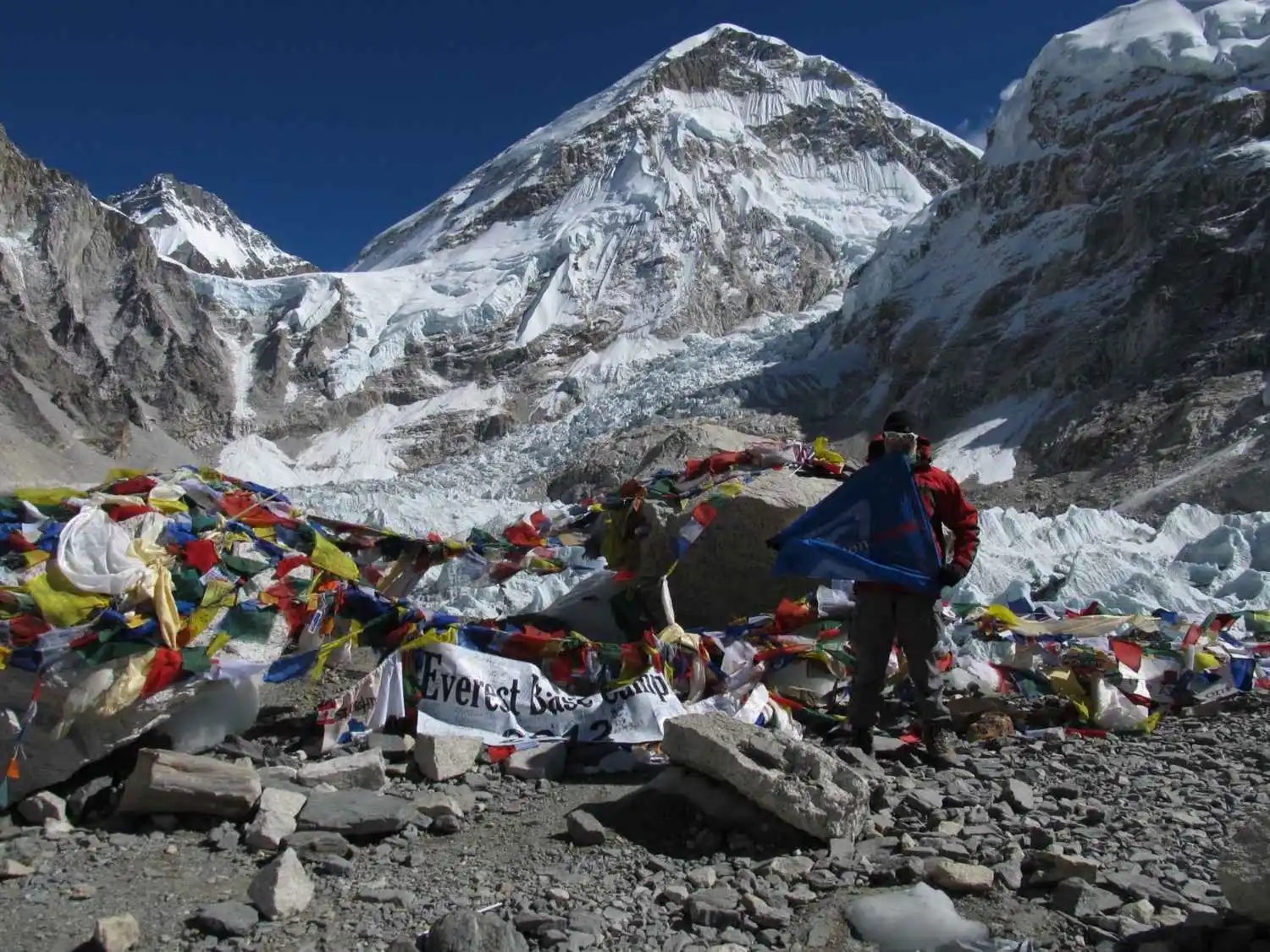
This is the day you've been building toward. Everything, the early mornings, the altitude headaches, and the aching legs, has been leading here. The trail follows the lateral moraines of the Khumbu region to Gorakshep, where you'll drop your bags at the teahouse before making that final push to Everest Base Camp. The terrain is raw and otherworldly, with ice, rock, and glacier stretching out beneath the enormous faces of Pumori, Changtse, Lingtren, and Chumbu. When you finally arrive at base camp and see the colored tents of expedition teams scattered across the Khumbu Glacier below the Khumbu Icefall, the emotion catches most people off guard. You made it. Take your time here, breathe it in, take photos, and sit with the moment. Then make your way back to Gorakshep, where a well-earned dinner and a good night's rest are waiting.
One last early wake-up, this one for Kalapatthar. The hike up in the pre-dawn darkness is cold and quiet and a little breathless, but when the sun breaks over the horizon and floods Everest's summit in a wash of amber and pink, the whole world looks different. This is the highest point of the entire trek and arguably its most iconic view. Take it all in. Back down at Gorakshep, you'll have breakfast before boarding the helicopter that lifts you away from this high-altitude world in a matter of minutes; what took eight days on foot is rewound in one sweeping, panoramic flight to Lukla. From Lukla, a short plane ride brings you back to Kathmandu, where a hot shower and a real bed have never felt more deserved. The rest of the day is yours; wander the city, shop for souvenirs, or simply sit somewhere quiet and think about what you just did.
Because your next adventure is impatiently waiting for you.
Last Minute Note: Grab incredible deals on the last minute departure / Book spontaneous trips to hip destinations with limited-time offers and discounted price
Before you think of or actually plan any adventurous or relaxing tours, travels, or treks with Nepal Outdoor Expeditions.